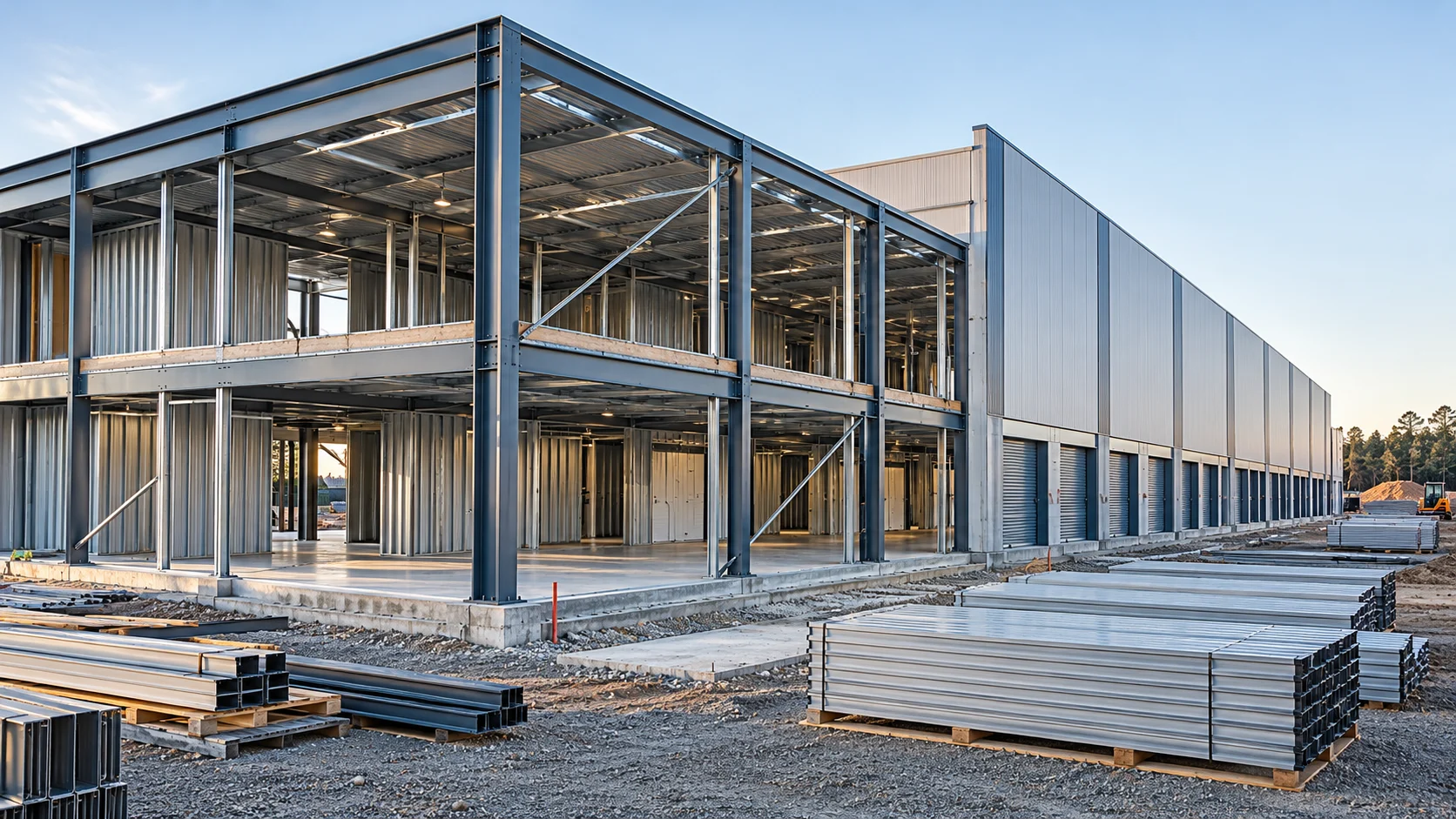
Conceptual visualization · illustrative examples are not market data.
Price a defined project
A useful cost estimate describes what is being purchased. Before comparing totals, define whether the project is a new build, an acquisition with refurbishment, a leased conversion or a staged container installation. Those routes have different cost categories and timing. Do not combine a complete building acquisition with a complete new-build allowance unless the scope genuinely includes both. Record the area basis, service level, location, estimate date and exclusions. A cost per square foot without those details can look precise while answering a different question from the one being asked.
Keep the major packages visible
Break the estimate into land or acquisition, site preparation, building work, storage fit-out, equipment, professional fees and opening cash needs. Within fit-out, identify partitions, doors, access hardware and any vertical circulation. Within site work, capture surfaces, drainage and utility connections. Ask each supplier which interfaces are excluded. A door quote may not cover the supporting opening; equipment may require electrical work priced elsewhere. A scope matrix with one responsible party per interface is more useful than a single undifferentiated contingency percentage.
Allow for uncertainty without disguising it
A contingency is not a substitute for investigating a major unknown. Keep known work, estimate allowances and unresolved risks in separate columns. For illustration only, if a C$400,000 package is still uncertain by C$80,000, the decision-maker should see that exposure directly. Do not label the total as a market benchmark. Add a risk note describing what would narrow the range: a site investigation, a design decision or a competitive quote. Update the budget when the evidence changes and preserve the previous version for comparison.
Follow the money through time
The same total project cost can produce different financing needs depending on deposits, progress payments and the date rent begins. Create a monthly draw schedule and distinguish recoverable deposits from expenses. Keep borrowing fees and interest separate from construction packages. Confirm tax treatment with an adviser rather than adding one national tax assumption. CRA guidance bases GST/HST rates on place of supply and the nature of the supply. The treatment and timing of input tax credits also need a project-specific review before relying on a net-cost budget.
Test the budget against the operating plan
A lower initial cost may create a higher recurring obligation, so compare alternatives over a stated period. Request maintenance information and replacement assumptions for major systems. Include opening staff, training, marketing and a reserve for the lease-up period. Capital expenditure belongs in the investment and cash schedules; it should not be silently inserted into routine operating expenses. Use the Lab to test a construction overrun and delayed opening together. Present the resulting funding gap, not just the eventual stabilized income, when deciding whether the project remains feasible.
Checked 2026-10-27 · Canada; authority and adoption of model codes, not site-specific approval.CRA — Charge and collect the GST/HST ↗
Checked 2026-10-27 · Canada; place-of-supply and tax-rate guidance. Tax applicability must be assessed separately.