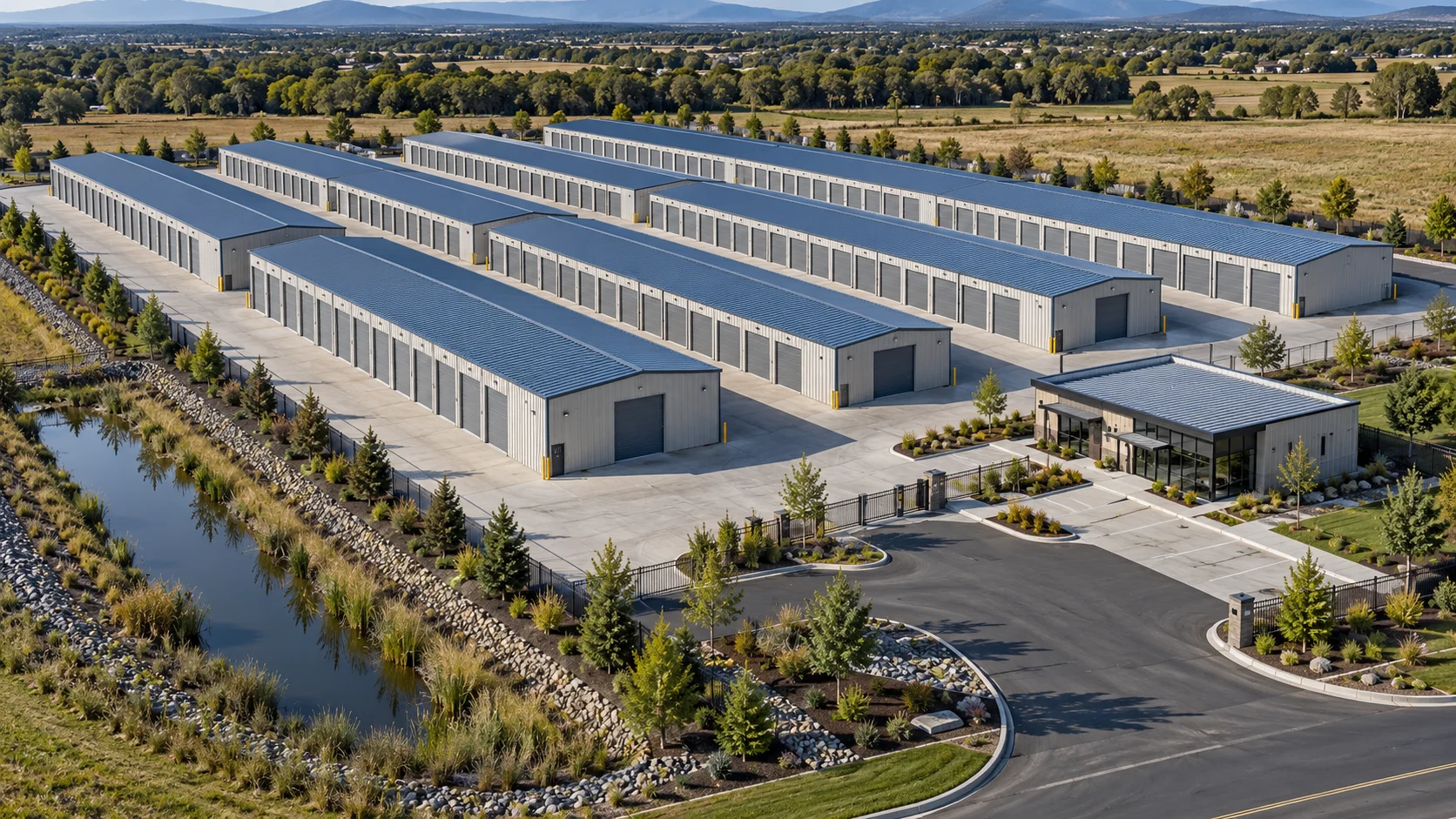
Conceptual visualization · illustrative examples are not market data.
Start with explicit definitions
Occupancy is a family of measures. Physical occupancy by unit count divides rented units by the stated unit denominator. Area occupancy divides occupied rentable area by total rentable area. Economic occupancy compares effective rental revenue with gross potential rental revenue for the same period and inventory. Define whether the physical denominator includes units temporarily unavailable for maintenance. A facility reporting rentable units only may appear fuller than one including all completed units. State the choice consistently in both the dashboard and exported report so comparisons are meaningful.
Work through a mixed-size example
Suppose a purely illustrative facility has ten 50-square-foot units and ten 200-square-foot units. If all ten small units are rented and all large units are vacant, physical occupancy is 50%, while area occupancy is 20%. Neither number is wrong; they answer different questions. If the small units have assumed rents of C$100 and large units C$300, full potential rent is C$4,000. Collecting C$1,000 without concessions produces 25% economic occupancy. These invented values demonstrate the definitions and must not be read as observed Canadian rental rates.
Follow the gap between potential and collected rent
Build a reconciliation from potential rent to rental revenue. Show vacancy loss, free-rent concessions, discounts and collection losses on separate lines. Do not subtract the same concession twice by reducing both the advertised rate and the final revenue again. Decide whether the model is using earned revenue or cash collections, since an unpaid invoice creates a timing question as well as a risk. The educational Lab uses stated assumptions and labels its method. An operating business should reconcile the chosen measure to its ledger and bank records.
Treat reservations and unavailable units carefully
A reservation is not necessarily a completed rental, and a blocked unit is not a paying customer. Keep these states distinct in an operating system or simulation. If a unit is unavailable after water damage, show the lost capacity and the repair cost without marking it occupied. If a reservation requires a refundable deposit, account for the deposit separately from rent. When simulating move-ins and move-outs, constrain occupied units to the actual capacity and explain how partial-month charges are handled. Visually coloured boxes should always correspond to a defined numerical state.
Use several measures to diagnose the issue
High physical occupancy with weak economic occupancy may indicate concessions, rate differences or collection problems. Low unit occupancy with stronger area occupancy may reflect demand for larger units. These are prompts for investigation rather than automatic diagnoses. Compare category-level performance, customer turnover and the age of receivables. In the simulator, change one variable at a time to understand its effect, then combine plausible stresses. Export the definitions with the result. An occupancy percentage without its denominator, period and revenue method is not a sufficient basis for a business decision.